
Ben Baddeley – Total Contact Insoles (TCI’s)
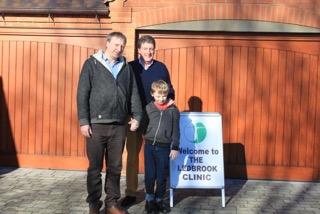
Ben is 12 years old and has Cerebral Palsy. Ben is receiving treatment at the Ledbrook Clinic for Total Contact Insoles(TCI’s). The insoles provide intimate contact with the whole of the under surface of the foot, and helps with Proprioception.
 Proprioception is the ability to sense stimuli arising within the body regarding position, motion, and equilibrium. Even if a person is blindfolded, he or she knows through proprioception if an arm is above the head or hanging by the side of the body. The sense of proprioception is disturbed in many neurological disorders. It can sometimes be improved through the use of sensory integration therapy, a type of specialised occupational therapy.
What do Total Contact Insoles do?
By virtue of its intimate contact with the foot and its areas of varying density, it provides forces to both control the foot position and also re-distribute pressures underneath the foot.
Ben’s story can be seen on his FB page
Ben’s story. Told by his father, Gary.
Ben has spastic Diplegia cerebral palsy. He got this through lack of oxygen at birth causing scarring on the brain. This caused severe pain 24 hours a day.
When Ben was 8 his consultant at North Staffs advised against further Botox as it was beginning to erode his muscles.
At this point in Ben’s life he was wearing plastic splints to hold his feet at a 90° angle & a metal body brace to hold his legs apart to allow him to sit down & stand for short periods of time.
The spasticity in CP sufferers is excruciating pain as well as horrendous muscle spasms.
Ben was in constant pain, couldn’t attend school for a full day due to the pain & his meds made him sick. He couldn’t read or write because he had regular headaches & was constantly grey.
Ben was sent to the Nottingham QMC & accepted as an excellent candidate for SDR spinal surgery.
This surgery involves removing 2 vertebrae & locating the nerves that cause the spasticity from the brain damage.
Those nerves are cut so as they never re-join & therefore permanently curing & removing the spasticity & tightness as well as allowing the muscles to develop.
Spasticity stops muscle development; the muscles simply do not work because the spasticity stops the growth. After surgery these muscles become functional & with intense specialist treatment for rehabilitation those muscles will learn to work correctly & give the body a chance to walk.
Ben went through 2 years of pre-op tests & treatment on the NHS (at the appropriate cost of 20k to the NHS)
He was taken off all his pain medication & fully prepared for surgery. Just 5 days before Ben’s surgery date the NHS sent us a letter to say the surgery was canceled due to funding cuts.
The NHS told us that the only way for Ben’s surgery to go ahead was to help with the cost to complete the surgery or wait to see if it ever comes back on the NHS
Ben was very lucky & an anonymous donator helped to cover the remaining balance to finish off the surgery.
Ben’s surgery went ahead, he went into hospital a wheelchair user & 5 hours after surgery he took his very first un aided steps. 2 days later he walked out of hospital with very little help.
We had only been out of hospital a matter of days when the NHS informed us that they now consider Ben’s surgery to have been private because we funded part of the operation & will not now fund any of his rehabilitation or medical treatment.
To fund Ben’s treatment it is costing us just under 2k every month. Ben requires 3 sessions of SDR rehabilitation treatment every week at the cost of £150 per hourly session. His progression is really good after this operation. He is out of a wheelchair. He is now out of the body brace and splints and is doing things he has never been able to do before.
He is also living a pain free life. Ben is at a vital stage with his physiotherapy. We have to keep this up to help train his muscles and build them all up. He has to do physio and stretching two hours a day every day. The physiotherapist gives him new targets every time she comes which he works hard on every day.
We have to have a trained SDR physiotherapist. The closest one to us is Wolverhampton which is why the cost is high as we have to pay for the travel.